
How to Choose the Right Laser Nozzle for Fiber Laser Cutting: A Complete Guide
The laser nozzle is one of the most critical consumables in fiber laser cutting. It directly affects cut quality, cutting speed, and overall efficiency. Yet many operators struggle with nozzle selection, leading to poor edge quality, excessive dross, and wasted materials.
In this comprehensive guide, we will walk you through everything you need to know about choosing the right laser nozzle for your fiber laser cutting application.
What Is a Laser Cutting Nozzle and Why Does It Matter?
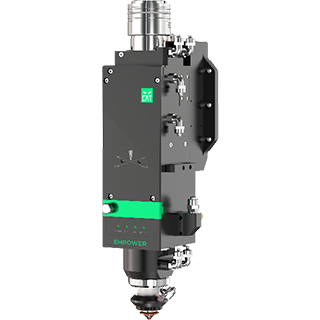
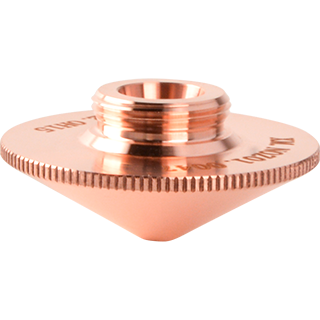
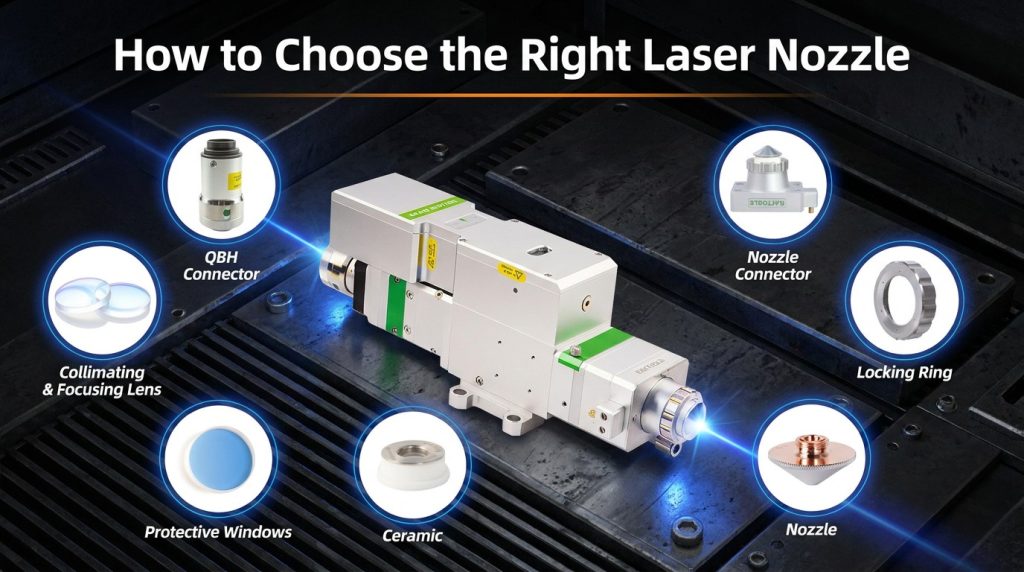
A laser cutting nozzle is the final component in the laser cutting head that directs the laser beam and assist gas onto the workpiece. Despite its small size, the nozzle plays several crucial roles:
- Beam guidance: The nozzle internal geometry helps shape and focus the laser beam as it exits the cutting head
- Gas distribution: It channels the assist gas (oxygen, nitrogen, or compressed air) concentrically around the beam
- Protection: The nozzle protects the expensive internal optics from spatter, debris, and contamination
- Quality control: Proper nozzle selection ensures clean cuts with minimal dross and burrs
A worn, damaged, or incorrectly sized nozzle can cause:
- Rough cut edges with excessive burrs
- Incomplete cuts through the material
- Uneven kerf width
- Increased gas consumption
- Frequent lens contamination
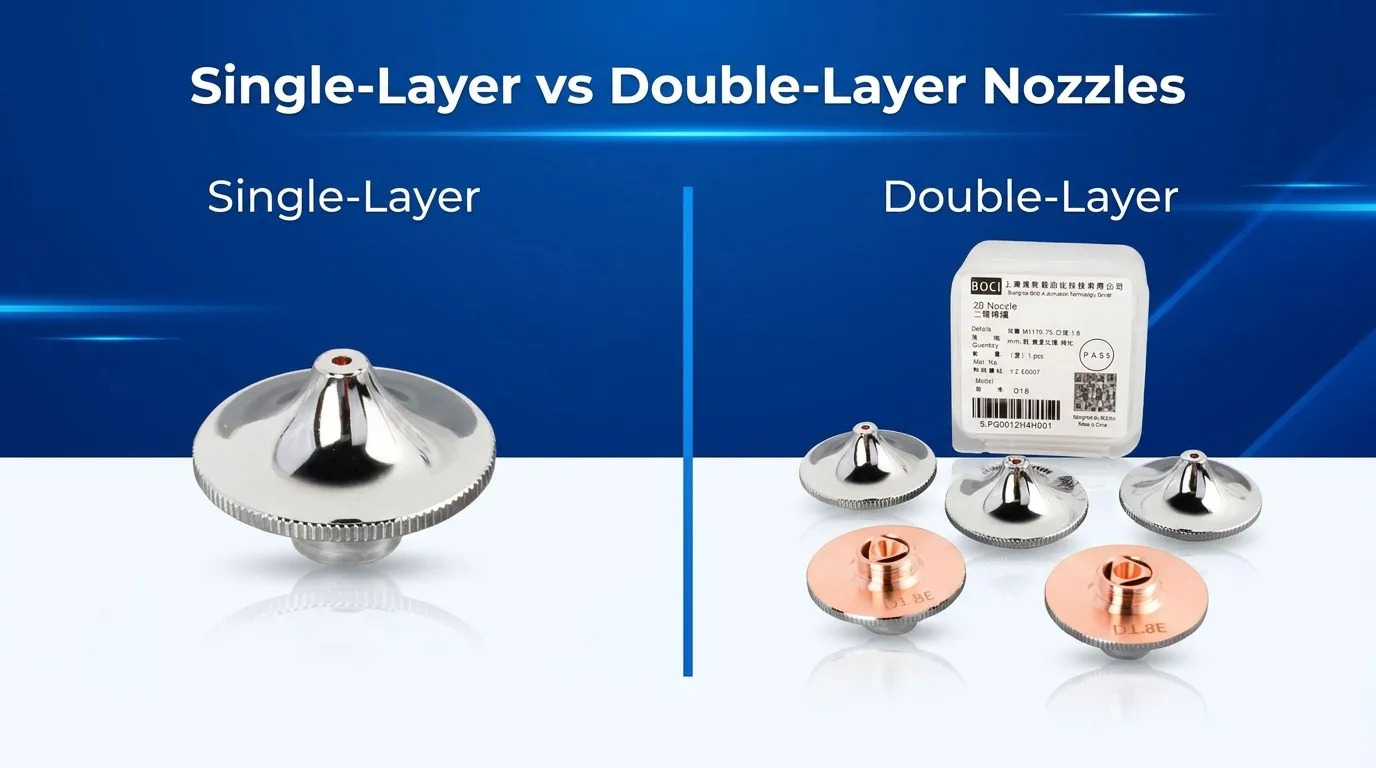
Single-Layer vs. Double-Layer Nozzles: What is the Difference?
Laser nozzles come in two main designs: single-layer and double-layer. Understanding the difference is essential for selecting the right nozzle for your application.
Single-Layer Nozzles
Single-layer nozzles have a simpler internal structure with one gas channel. They are typically used for:
- Nitrogen cutting: When cutting stainless steel or aluminum with nitrogen as the assist gas
- Thin materials: Materials up to 6mm thickness
- High-speed cutting: Where clean, oxide-free edges are required
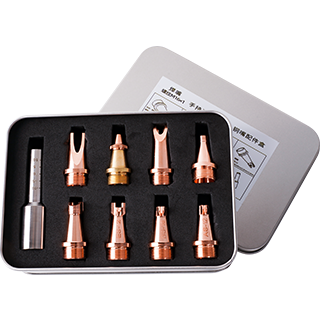
Common single-layer nozzle types include:
- Type A: Standard design for general-purpose cutting
- EBG/EBD: Enhanced gas flow design for improved cut quality
- ECE: High-precision design for thin sheet cutting
Double-Layer Nozzles
Double-layer nozzles feature an inner and outer gas channel, providing better gas flow control. They are ideal for:
- Oxygen cutting: When cutting carbon steel with oxygen
- Thick materials: Materials from 6mm to 25mm+ thickness
- High-power applications: 6kW and above
Popular double-layer nozzle designs include:
- D28 series: Standard design for most cutting heads
- Supersonic/Pressurized: Enhanced gas velocity for thicker materials
- Boost version: Optimized for maximum cutting speed
How to Select the Right Nozzle Diameter
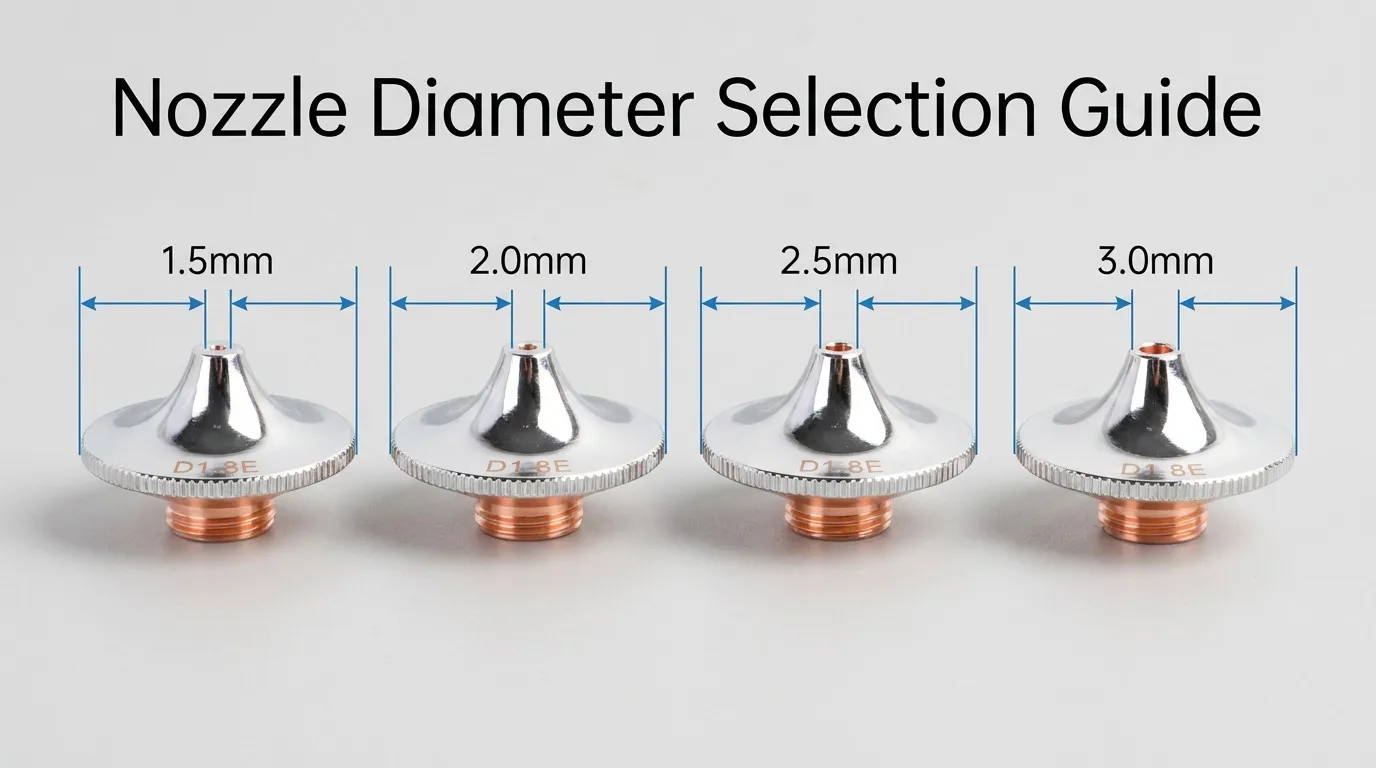
Nozzle diameter is specified by the orifice size (D1.0, D1.5, D2.0, D2.5, D3.0, etc.). The right diameter depends on your material thickness and cutting requirements.
General Guidelines
| Material Thickness | Recommended Nozzle Diameter | Typical Application |
|---|---|---|
| 0.5 – 2mm | D1.0 – D1.5 | Thin sheet metal, high-speed cutting |
| 2 – 6mm | D1.5 – D2.0 | General fabrication, signage |
| 6 – 12mm | D2.0 – D2.5 | Structural steel, heavy fabrication |
| 12 – 25mm+ | D2.5 – D3.2 | Thick plate cutting, shipbuilding |
Why Diameter Matters
Too small: Restricted gas flow leads to incomplete cuts, excessive dross, and slow cutting speeds.
Too large: Gas disperses too widely, reducing cutting efficiency and increasing gas consumption. The kerf width also increases, wasting material.
Just right: Optimal gas concentration at the cut point ensures clean edges, maximum speed, and minimal gas waste.
Nozzle Compatibility: Matching Your Cutting Head
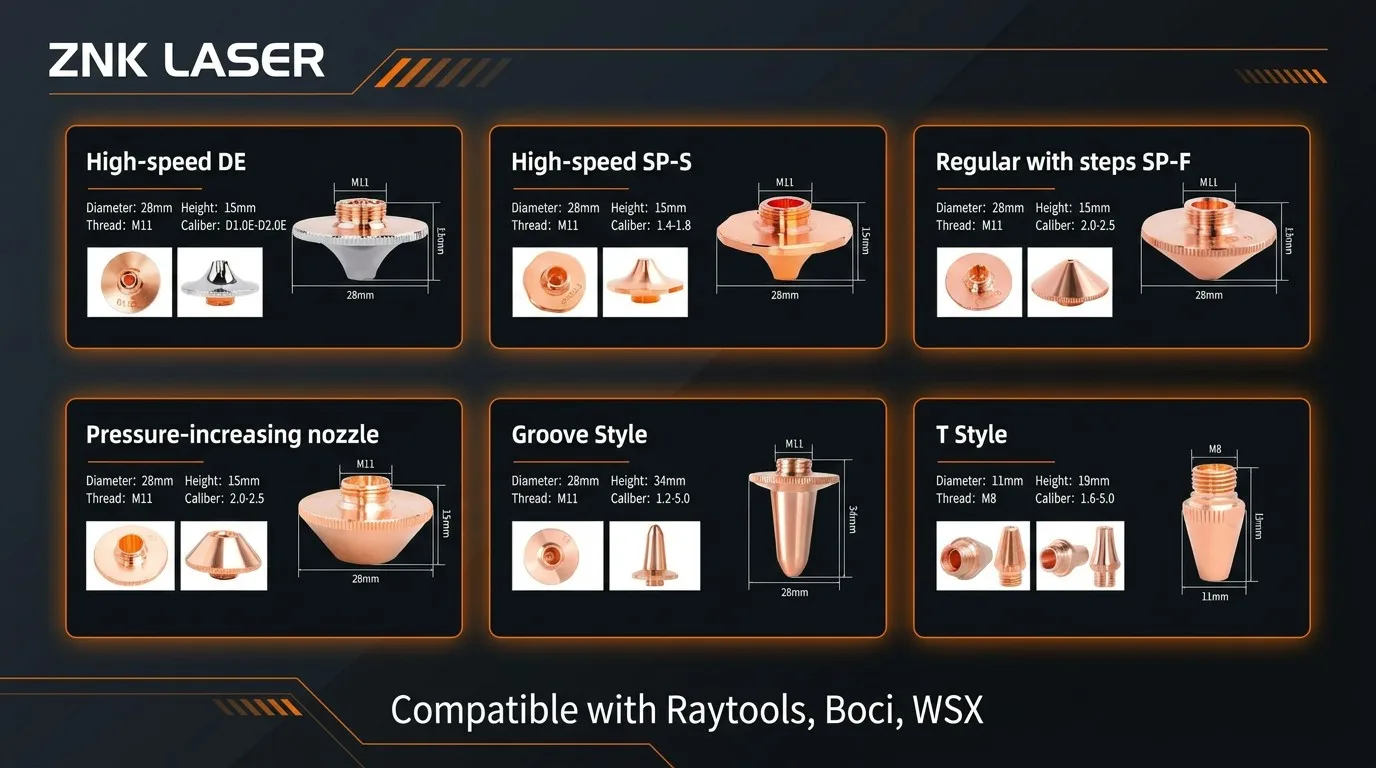
Not all nozzles fit all cutting heads. Each cutting head brand has specific nozzle requirements.
Raytools Cutting Heads
Raytools is one of the most popular cutting head brands, used in machines from 1kW to 20kW. Compatible nozzles include:
- B Type nozzles (D28 H15 M11): Standard for BS12K/BS15K/BS20K heads
- C Type nozzles: For BS12K/BS15K single-layer applications
- G Type 3D nozzles: For 3D cutting applications
Boci Cutting Heads
Boci cutting heads are known for their precision and durability. Compatible nozzles:
- BOCI D28 H15 M11: High-speed design for efficient cutting
- Standard D28 series with Boci-specific threading
WSX Cutting Heads
WSX cutting heads use a different thread pattern. Compatible nozzles:
- WSX D14 H15 M11 nozzles: Specifically designed for WSX heads
Other Brands
We also supply nozzles compatible with:
- OSPRI: D28 and M8 3D nozzles
- HSG: D28 H15 M11 specifications
- Mazak: D10.5 H12 M5 nozzles for Mazak Optiplex machines
- EAA/EAU/ECU: Standard E-type nozzles for various heads
Pro tip: Always verify your cutting head model before ordering nozzles. The thread size (M6, M8, M9, M11, M12, M14) and nozzle dimensions must match exactly.
Nozzle Material: Copper vs. Brass
The material of your nozzle affects both performance and cost.
Pure Copper Nozzles
- Advantages: Superior thermal conductivity, better gas flow, longer lifespan
- Best for: High-power cutting (6kW+), precision applications
- Cost: Higher initial cost, but better long-term value
Brass Nozzles
- Advantages: Lower cost, adequate for many applications
- Best for: Low to medium power cutting, budget-conscious operations
- Cost: Lower initial cost, but may need more frequent replacement
Our recommendation: For production environments running 8+ hours daily, invest in pure copper nozzles. The improved cut quality and longer lifespan justify the higher upfront cost.
When to Replace Your Laser Nozzle
Even the best nozzles wear out over time. Here are signs it is time for a replacement:
Visual Inspection
- Orifice damage: The hole is no longer perfectly round
- Spatter buildup: Metal spatter on the nozzle face that will not clean off
- Thread wear: Difficulty screwing the nozzle in or out
- Discoloration: Excessive heat damage or oxidation
Performance Indicators
- Cut quality suddenly degrades despite correct settings
- Increased dross on the bottom of cuts
- Uneven kerf width across the cut
- More frequent lens contamination
- Higher gas consumption than normal
Typical Lifespan
As a general guideline:
- High-volume production: Replace every 2-4 weeks
- Moderate use: Replace every 1-2 months
- Light use: Replace every 3-6 months
Best Practices for Nozzle Maintenance
Daily Maintenance
- Visual inspection: Check for spatter, damage, or wear before each shift
- Clean the nozzle: Use a soft cloth and isopropyl alcohol to remove spatter
- Check the orifice: Ensure it is clean and round
- Verify alignment: Use a nozzle aligner to check beam centering
Weekly Maintenance
- Deep cleaning: Remove the nozzle and clean the internal gas channels
- Inspect threads: Check for wear or cross-threading
- Measure the orifice: Use a microscope or magnifier to check for deformation
Installation Tips
- Always use the correct wrench and never overtighten
- Apply a small amount of anti-seize compound to the threads
- Ensure the nozzle is seated properly before tightening
- Check standoff distance after installation
Troubleshooting Common Nozzle Problems
Problem: Rough Cut Edges
Possible causes: Worn or damaged nozzle orifice, incorrect nozzle diameter, misaligned beam.
Solution: Replace the nozzle, verify diameter selection, and realign the beam using a nozzle aligner.
Problem: Incomplete Cuts
Possible causes: Nozzle orifice too small, insufficient gas pressure, blocked nozzle.
Solution: Switch to a larger diameter nozzle, increase gas pressure, or clean and replace the nozzle.
Problem: Excessive Gas Consumption
Possible causes: Nozzle diameter too large, worn nozzle allowing gas leakage, incorrect standoff distance.
Solution: Use the correct nozzle size, replace worn nozzles, and verify standoff distance (typically 0.5-1.0mm).
Conclusion: Choosing the Right Nozzle for Your Application
Selecting the right laser nozzle does not have to be complicated. By understanding your cutting head compatibility, material requirements, and application needs, you can make an informed choice that improves cut quality, reduces costs, and increases productivity.
Key takeaways:
- Match nozzle type (single vs. double layer) to your cutting process
- Select the correct diameter based on material thickness
- Verify compatibility with your specific cutting head brand and model
- Invest in quality copper nozzles for production environments
- Implement regular maintenance to extend nozzle life
At ZNK LASER, we supply a comprehensive range of fiber laser cutting nozzles compatible with all major cutting head brands. From standard D28 nozzles to specialized 3D cutting nozzles, we have the right solution for your application.
Browse our complete laser nozzle catalog
Questions about nozzle selection? Contact our technical team for personalized recommendations.